
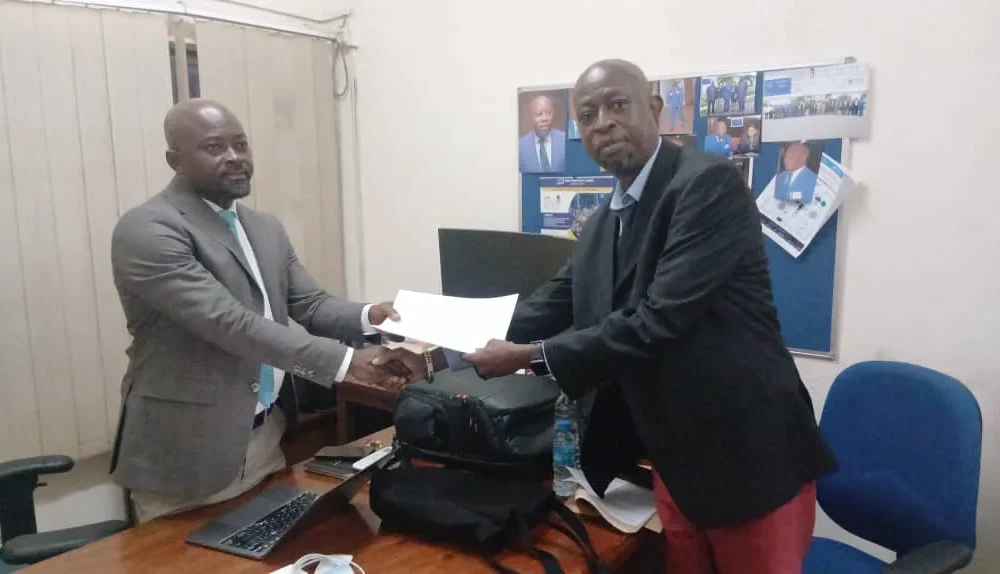
Social Linkages for Youth Development and Child Link (SLYDCL) has renewed its call for a review of Sierra Leone’s drug laws, presenting a 15-page policy brief to newly appointed National Drug Law Enforcement Agency (NDLEA) Executive Director Prince Bull-Luceni.
The brief was handed over during a courtesy visit to Bull-Luceni’s office by a delegation led by SLYDCL Executive Director Habib T. Kamara. The organisation said its recommendations address prevention, treatment, rehabilitation, harm reduction, recovery and social reintegration.
Bull-Luceni was appointed to lead the NDLEA on August 11, 2026. Before taking the position, he served as the agency’s Deputy Executive Director.
Focus on the 2008 law
SLYDCL’s document calls for a review of the National Drugs Control Act of 2008. The organisation provides medical care, rehabilitation support and education to at-risk young people and children affected by drugs, while promoting evidence-based, human rights-centred and public-health approaches to drug prevention and control.
The policy brief’s executive summary says: “Sierra Leone’s drug situation has changed substantially since 2008. The country is now confronting increasingly diverse and unpredictable substances, including the synthetic-drug crisis associated with Kush, while also expanding efforts around treatment, rehabilitation, harm reduction, HIV prevention, overdose prevention and community-based services.”
SLYDCL said the changing nature of the country’s drug crisis makes it necessary to reassess the approaches contained in the existing legal framework.
Under the current Act, unlawful buying, selling, possession, control or use of drugs carries a prison sentence of not less than five years. The law also includes treatment-oriented provisions in Part IV, covering treatment assessment panels, treatment orders and the suspension of penalties.
Calls for a more balanced framework
Campaigners have argued that the legislation does not sufficiently distinguish between people who use drugs and those involved in the manufacture or trafficking of illegal substances. They have also raised concerns that possession and personal use are dealt with within the same criminal framework as wider drug offences.
According to campaigners, the combination of punitive provisions and treatment measures has made it difficult to establish an effective and balanced drug-control system.
SLYDCL’s delegation expressed its commitment to continued collaboration with the NDLEA in responding to drug-related challenges across Sierra Leone. The law remains a key foundation for controlling illicit drug trafficking and organised drug-related crimes, while the organisation’s policy brief seeks changes that place greater emphasis on public health, recovery and reintegration.





No Comment! Be the first one.